September 2026
Two women sit in the same waiting room.
One is slim. She has been slim her whole life, has never dieted, and has never once been asked about her weight at an appointment. The other is not slim. She has been asked about her weight at nearly every appointment she has ever had, including the ones about her ankle and her sinuses.
Both of them are tired in the afternoons. Both have noticed their energy is not what it was.
If you measured them properly, you might find that both are dealing with the same underlying problem. Or that one is and one is not. What you could not do is tell from looking, and neither could I. The thing that matters here is not visible, and it is not what the scale reports.
That is what this issue is about.
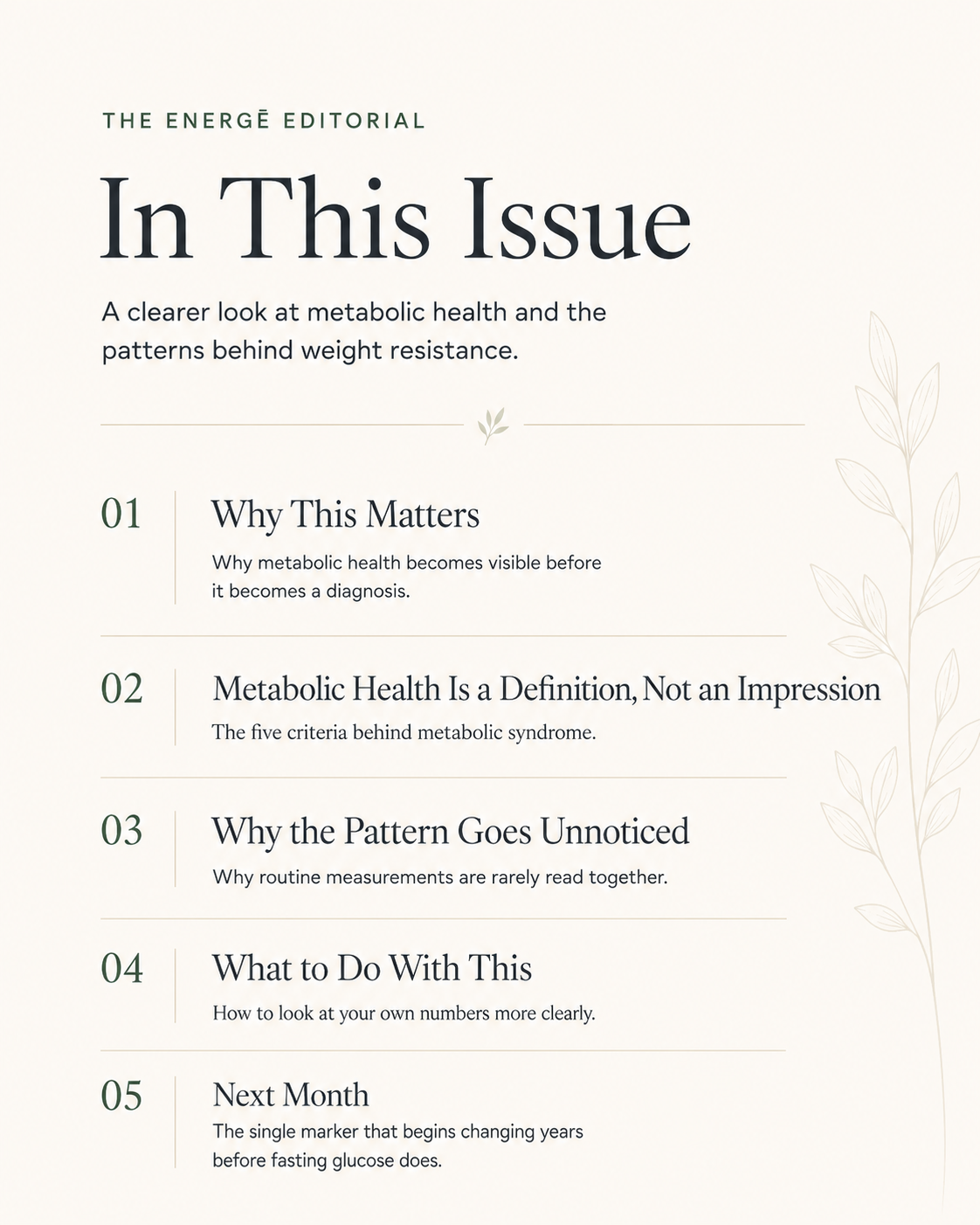
Why this matters
It is worth saying plainly why any of this matters. Metabolic health describes how well your body takes in fuel, uses it, and stores what is left. When that process is working, energy is steady and the system absorbs ordinary demands without much trouble. When it is not, the effects accumulate quietly and over years — in energy, in sleep, in mood, in how the body handles stress and recovery, and eventually in risk of type 2 diabetes, heart disease, and stroke. Almost none of that announces itself early. The measurements below are how it becomes visible before it becomes a diagnosis.
Metabolic health is a definition, not an impression
Metabolic syndrome is a recognized clinical diagnosis with five criteria. Meeting any three of the five is the definition.
1. Waist circumference
Measured around the abdomen at the level of the top of the hip bones, not at the narrowest point and not where your jeans sit. For women, 35 in or more meets this criterion. It is a rough proxy for how much fat is being stored around the organs rather than under the skin, and those two kinds of storage behave very differently.
2. Triglycerides
A form of fat carried in the blood. 150mg/dL or higher meets the criterion. Triglycerides rise when the body is taking in more fuel than it is using efficiently, and the excess is packaged up and sent into circulation. This is often the first of the five to shift, which makes it an early signal rather than a late one.
3. HDL cholesterol
For women, below 50mg/dL meets the criterion. HDL is the particle that carries cholesterol away from the tissues and back to the liver for removal. It tends to fall as this pattern develops, which is why a low HDL sitting next to a high triglyceride is far more meaningful than either number alone.
4. Blood pressure
130/85 mmHg or higher, or already taking medication for it. Blood pressure reflects how hard the heart is working and how much resistance the vessels are offering. It rises in this pattern because the same processes that affect fuel handling also affect how vessels relax and how the kidneys manage fluid and salt.
5. Fasting glucose
100 mg/dL or higher, or already taking medication for it. This is the number most people have heard of, and it is the last of the five to move. Glucose stays where it should for a long time while the body works progressively harder to keep it there, which is why a normal fasting glucose is reassuring about today and says less about the years leading up to it.
Which is why a person can be slim and still meet the criteria
A woman at an ordinary weight can have a waist of thirty-five inches, triglycerides of one hundred eighty, and an HDL of forty-two. That is three of five. Nothing about her appearance would suggest it, and nobody has ever raised her weight with her, so nobody has thought to look.
A woman carrying considerably more weight can have a normal blood pressure, triglycerides of ninety, and an HDL of sixty-five. She meets one criterion, possibly two. Her weight has been discussed at every appointment for twenty years, and the conversation has been about the wrong thing that entire time.
Both of these women exist. Both are common.
The first is sometimes described as having normal weight obesity, and the second as being metabolically healthy at a higher weight — both awkward phrases for the same underlying point, which is that the outside and the inside are not reliably related.
The five criteria describe how a body is handling fuel. Weight describes how much of the body there is. Those are different questions, and only one of them is answered by a scale.
Why the pattern goes unnoticed
Four of these five measurements are already being taken on most women, routinely, and they are almost never read together.
Triglycerides and HDL live on a lipid panel, where they are interpreted as cardiovascular numbers. Fasting glucose lives on a metabolic panel, where it is interpreted as a diabetes screen. Blood pressure is taken at the start of the visit and recorded. Each one is looked at in its own context, against its own reference range, and each one individually can look unremarkable.
The fifth, waist circumference, is rarely measured at all. It takes a tape measure and thirty seconds, and it is the one of the five that most often goes missing.
So the pattern exists across four different places in a chart and nowhere in particular. A triglyceride of one hundred sixty is a mild note on a lipid panel. A glucose of one hundred one is a mild note on a metabolic panel. Together with a waist of thirty-six inches, they are something with a name.
And when a woman looks well, nobody assembles them. That is not carelessness. It is what happens when results are read one page at a time.
What to do with this
You may already have four of these five numbers.
Look at any bloodwork from the past year or two. A lipid panel will have your triglycerides and your HDL. A metabolic panel will have your fasting glucose. Your blood pressure is likely recorded at the top of a visit note. A tape measure gives you the fifth, at the level of the top of your hip bones, at the end of a normal breath out.
What this exercise gives you is different and still worth having: you will know which of the five have been measured, and which have never been looked at.
Then the question for your next appointment is a specific one. Have these five been considered together?
If the answer is that they have not, that is worth knowing. It is a more useful thing to know than your weight.